QUESTION: What sense do you get of what life was like in Elizabethan England? Try to include information on: The population, entertainment, religion, superstition, money, jobs, medicine, theatre.

Shakespeare lived in Elizabethan England. The Elizabethan Era, the period associated with the reign of Queen Elizabeth I (1558–1603) that is often considered to be a golden age in English history, Historians studying it have focused mainly on the lives of the era's wealthy nobles. There was a dominant patriarchate society and a strong belief in Christian which put the noble men nearest to god and the Queen worshiped by rest of the population. So this meant that the barons, prices, dukes and landowners spent their days royally feasting and courting dressed in grand robes (Like Elizabeth I on the left) while jesters played instruments. But the conditions of the ordinary folk were on the complete opposite end of the spectrum. Shakespeare never writes about peasants and commoners whom he would've mostly grown up around and was initially associated to. His plots always tend to follow nobility and aristocracy. But the living conditions of most of Elizabethan population were brutal, miserable and dangerously unhealthy. The average working man would not be able to provide nearly enough by our measure for his seven children and would naturally not have the contraception not to have them. The peasant women were illiterate and thus paid nothing they could earn their own living for let alone provide. So things like baths, clean water, a balanced diet, rodent-free household, heat and other necessities were considered a luxury. Lack medical attention as well as knowledge meant that the majority suffered from low life expectancy and were victim to brutal things such as the Bubonic plague. This lack of a healthcare system and medicinal ignorance meant that half the entire population was under the age of twenty two. As if this wasn't enough, the poor folk forced to take up a life of even the pettiest crime were immediately punishable by death. A peasant could end up in the gallows after having stole their family a ten pence supper. As if the chances of getting poisoned by bad meat or something of the sort weren't ridiculously high enough anyway.


Elizabethan England is dominated by the filthy rich in decadent high candlelit ceilings in powerful gold-coated seats but this is a world enjoyed by the privileged few. People born poor couldn't marry into money because of how almost non existent marriage outside their class was and they couldn't get a solid enough education because schooling was rare and expensive. Candles are expensive in cramped peasant cottages and life is definitely a very different kettle of bitter darkness in most people's case.
The jobs that most of the population were educated enough to do would be considered demeaning, unholy and unworthy which is where they got this ridiculously low income. The educated and wealthy were only people of noble birth and the ordained few. The religion in The Elizabethan era was highly Christian but nobility was a close second. Peasants were't educated enough about Christianity and worshiped the Queen as God's chosen aristocrat.
Here are some of the jobs there's record of:
APOTHECARY
An Apothecy dispensed remedies made from herbs, plants and roots. Elizabethan physicians were expensive and a priest often held this occupation, often the only recourse for sick, poor people
ARTIST
Artists were employed in the later Elizabethan era by kings and nobles. At first an artist painted heraldic designs on early furniture and then it became fashionable for portraits to be painted
ASTROLOGER
An astrologer studied the stars and planets but regarded as a mystical person.
BAKER
Bread was a daily staple of Elizabethan life, and good bakers were employed by Nobles in their castles.
BARBER
A Barber had many occupations in relation to personal care. Barbers would cut hair but would also serve as dentists, surgeons and blood-letters.
BLACKSMITH
The Blacksmith was one of the most important, albeit lowly, occupations of the Elizabethan era. Blacksmiths forged weapons, sharpened weapons, repaired armor.
BOTTLER
A Bottler had a responsible occupation and was in charge of the Bottlery which was intended for storing and dispensing wines and other expensive provisions.
BUTLER
The Butler was responsible for the castle cellar and was in charge of large butts of beer. The room in the castle called the Buttery was intended for storing and dispensing beverages, especially ale.
BOWER OR BOWYER
The Bowyer manufactured bows, arrows and crossbows

CANDLEMAKER
The Candlemaker made candles to light a castle or palace. Candles were supplemented by lighting from torches, lanterns and rush dips.
CARPENTER
The occupation of the Carpenter was diverse. Carpenters built furniture, roofing, and wood panelling. Carpenter: a skilled craftsman who shaped or made things of wood. Carpenters were highly skilled and considered to be elite tradesmen
CHAMBERLAIN
Chamberlain - The title originated with an officer of a royal household who was responsible for the Chamber, which included the administration of the Queen's household's budget. This occupation was later extended to collecting revenues and paying expenses
CHANCELLOR
A chancellor was a secretary to a Noble or Royal person
CHAPLAIN
The Chaplain was responsible for the religious activities of a castle servants and Men at arms. The duties might also include that of a clerk and keeping accounts. A Priest would usually looked after the spiritual needs and confessions of the Nobles and their families
CLERK
A Clerk was employed to keep accounts
CLOTHIER
Clothiers made clothes for the nobles and required having a knowledge of various fine and expensive materials
CONSTABLE
Constable was the occupation of the person who had been appointed as Custodian, or in charge of, the castle
COOK
Cook was employed in the castle kitchens roasting, broiling, and baking food in the fireplaces and ovens.
CORDWAINER
A Cordwainer was a Shoemaker or Cobbler, a craftsman who made shoes
COTTAR
A Cottar was one of the lowest peasant occupations, undertaken by the old or infirm, who had a series of low duties including swine-herd,, prison guard and menial tasks
EWERER
A Ewerer brought and heated water for nobles
FLETCHER
The Fletcher crafted and manufactured bows and the flights of arrows
GARDENER
The Elizabethan Gardener needed a knowledge of herbs and plants.
GONG FARMER
Gong was another name for dung.
HERALD OR HARKER
A Herald was a knights assistant and an expert advisor on heraldry. The Herald (or Harker) would declare announcements on behalf of the Queen or Noble to the public. Normally this was done on a given day when the public would assemble at the base of a castle tower or in the town square and the Herald would shout out the news
HERBALIST
A Herbalist was usually a member of a religious order such as a monk or friar who would plant and maintainmedicinal plants, roots and herbs.
JANITOR
The Janitor, or Porter, was responsible for a main Castle entrance and for the guardrooms. The Janitor also insured that no one entered or left the castle without permission
JESTER
The Jester also referred to as the Fool entertained the Queen and the court
KEEPER OF THE WARDROBE
The room in the castle called the wardrobe was intended as a dressing room and storage room for clothes and used by the Queen and Upper Classes. The Keeper of the Wardrobe was in charge of the tailors and laundress.
KNIGHT
It was the duty of a Knight to learn how to fight and so serve their Queen according to the Code of Chivalry. Weapon practise included enhancing skills in the sword, battle axe, dagger and lance.
MARSHAL
Marshal was the officer in charge of a household's horses, carts, wagons, containers and the transporting of goods.
MESSENGER
Messengers were lesser diplomats of the lord who carried receipts, letters, and commodities.
MINSTREL
Minstrels provided Castle entertainment in the form of singing and playing musical instruments. Minstrels often would record the deeds of heroic knights in songs giving the knight great publicity and establishing respect and additional status
MONEYLENDER
Moneylenders were the Elizabethan bankers.
PAGE
The life of a castle Page would start at a very young age - seven years old. A Page was junior to a Squire. It was the duty of a Page to wait at table, care for the Lord's clothes and assist them in dressing. The Page was provided with a uniform of the colours and livery of the Lord.
PAINTER
Elizabethan castles ere highly colorful and the services of painters were often required
PORTER
The Janitor, or Porter, was responsible for a Castle entrance and for the guardrooms. The Porter also insured that no one entered or left the castle without permission
PHYSICIAN
Physicians were a very highly regarded and respected occupation. Bleeding, lancing and surgical procedures were practised.
POTTER
Potters were craftsmen of in clay, porcelain and early forms of ceramics. Basically they produced pots for cooking and storage and occasionally worked as sculptors. Potters were members of Elizabethan craft guilds
REEVE
The Reeve supervised all work on a lord's property. The Reeve ensured that everyone began and stopped work on time
SCRIBE
Most Scribes came from religious establishments where reading, writing and comprehension skills were learned.
SCULLION
Scullions were the lowest of kitchen workers whose duties included washing and cleaning the kitchen
SHERIFF
The sheriff was an important official of county who was responsible for executing judicial duties
SHOEMAKER
A Shoemaker or Cobbler or Cordwainer was a craftsman who made shoes
SPINSTER
Spinster was the name of the occupation given to a woman who earned her living spinning yarn. The Spinning Wheel was invented during the Elizabethan era. Later the term Spinster was used to describe any unmarried woman
STEWARD
The Steward took care of castle estates and household administration including the events in the Great Hall.
SQUIRE
A Squire was junior to a Knight. It was the duty of a Squire to learn about the Code of Chivalry, the rules of Heraldry, horsemanship and practice the use of weapons. It was also their duty to enter into court life and learn courtly etiquette, music and dancing.
WATCHMAN
Watchmen was an official at the castle responsible for security. Also night-watchman
There were no analytical newspapers or uncensored sources of political opinions just word of mouth and stories. The best form of storytelling was the theatre and that of Shakespeare's washed over all classes of people. The melodramatic palatable entertainment began to turn into the only mirror for there was for Elizabethan society. The role of Shakespere in London was similarly to today's media analysing how power corrupts and hedonistic goals don't justify brutal means.The century before Shakespeare's birth had seen a renaissance of classical knowledge and by the 16th century society of Elizabethan England was daring to question this ancient knowledge. The was suddenly room to look beyond the limitations and discover fact unheard about the world we live in. For example question medieval medicine's frankly ignorant ideas. By now anatomies started being performed, stripping away the flesh and confronting the reality of human condition. In a way that's also what Shakespeare started doing in his plays. Showing us as we really are with our multi layered human beings with all of our subtleties and contradictions. It was this very growing sense of self awareness and self knowledge of the 16th century that drags us out of the medieval into the modern.

William Shakespeare April 1564 - April 23, 1616
To thine own self be true, and it must follow, as the night the day, thou canst not then be false to any man.
This is the man who has enriched the English language more than anyone or anything else in the world. His gift to the world was 1700 words, 37 plays and 154 sonnets which are now widely translated into most of the human languages and live on in theatres, classrooms, screens, hardback copies, the streets of the world and most importantly in people's hearts and mind. Shakespeare lived and died in Stratford-upon-Avon of Elizabethan England yet the of treasure in his work can be found
relevant as ever to the 21st century world.
Lets go back to his beginning...
In a small English market town located about 100 miles north west of London along the banks of the River Avon. William Shakespeare was born the fourth of the eight Shakespeares children, only five of whom survived to adulthood.
His father John Shakespeare, was a prominent local citizen who served as an alderman and bailiff. His mother was Mary Arden Shakespeare, after whom Shakespeare named the Forest of Arden in the play As You Like It. The Arden family had been prominent in Warwickshire since before the Norman Conquest. Mary was the youngest of eight daughters. She inherited her father's farm in Wilmcote,Warwickshire when he died in December 1556. Richard Shakespeare, the father of John Shakespeare, was a tenant farmer on land owned by her father in Snitterfield. As the daughter of Richard's landlord; she may have known John since childhood. Mary married John Shakespeare in 1557, when she was 20 years old. She bore eight children. Though Mary gave birth to many children, several of them died young. Some members of the wider Arden family were of the Catholic faith.
in April 26, 1564, in Holy Trinity Church in Stratford-upon-Avon, William, son of John Shakespeare and Mary Arden, was baptised 100 miles northwest of London, on April 26, 1564 in Holy Trinity Church.
By the age of four or five, young William Shakespeare was enrolled at the King's New School in Stratford, a grammar school run for the benefit of the sons of civil servants like John Shakespeare. Where the sons of Stratford's merchant class came to learn the skills to inherit the family business. This was a time of profound transformation when education was moving out of the homes of the privileged few into the schools welcoming children of humble ordinary glove-makers like Shakespeare. Schooling was no longer heavily controlled by the church offering scholarships for the town's deserving poor and charging fees for those better off.
By today's standards, the education that boys like William Shakespeare received at these grammar schools was incredibly rigorous. The King's New School curriculum would have stressed a classical education of Greek mythology, Roman comedy, ancient history, rhetoric, grammar, Latin, and possibly Greek. Throughout his childhood, Shakespeare's father struggled with serious financial debt. Therefore, unlike his fellow playwright Christopher Marlowe, he did not attend university. But after leaving school at the age of only sixteen, Shakespeare would have spoken more Latin than any classics graduate at University today. He'd have been saturated in the ancient world with Pliny, Aristotle, Plato and Socrates. He would've reached a point where one has such extensive knowledge of all the worlds discoveries, history philosophy and literature that they may place their own building block at the top of the tower.
Shakespeare was only 18 years old when he married Anne Hathaway: a local farmer’s daughter, eight years his senior. Most men at this time married in their mid to late 20s. So why did he marry so young? The answer came six months later, when their daughter, Susanna, was baptised in Holy Trinity Church. William and Anne had two more children, Hamnet and Judith who were twins, born in 1585. Anne and the three children probably lived with William’s parents at first. Later, they moved to New Place, a large house in Stratford. But Shakespeare spent most of his time 100 miles away, in London. Shakespeare initially came to London as a travelling player in the year of 1588. What he encountered there was a world of horizons pushed back. Then For several years after Judith and Hamnet's arrival in 1585, nothing is known for certain of Shakespeare's activities: how he earned a living, when he moved from Stratford, or how he got his start in the theatre. Following this gap in the record, the first definite mention of Shakespeare is in 1592 as an established London actor and playwright, mocked by a contemporary as a "Shake-scene."
From about 1590 to 1613, Shakespeare lived mainly in London and by 1592 was a well-known actor there. He began by writing sonnets but it wasn't until his play, Henry VI, was performed
at the Rose theatre in 1592 that he made his name as a playwright. He went on to write about 40 plays. Shakespeare was also a poet and in 1609 published a book of 154 sonnets.
Between 1590 and 1592, Shakespeare's Henry VI series, Richard III, and The Comedy of Errors were performed. When the theaters were closed in 1593 because of the plague. But Shakespeare was too engrossed in his writing to care about the plague. I bet he preferred the plague to a bad review because at least in that case the bloke that gave it to you dies... The playwright wrote two narrative poems, Venus and Adonis and The Rape of Lucrece, and probably began writing his richly textured sonnets. One hundred and fifty-four of his sonnets have survived, ensuring his reputation as a gifted poet. By 1594, he had also written, The Taming of the Shrew, The Two Gentlemen of Verona and Love's Labor's Lost.
Having established himself as an actor and playwright, in 1594 Shakespeare became a shareholder in the Lord Chamberlain's Men, one of the most popular acting companies in London. He remained a member of this company for the rest of his career, often playing before the court of Queen Elizabeth I. Shakespeare entered one of his most prolific periods around 1595, writing Richard II, Romeo and Juliet, A Midsummer Night's Dream, and The Merchant of Venice. With his new found success, Shakespeare purchased the second largest home in Stratford in 1597, though he continued to live in London. Two years later, he joined others from the Lord Chamberlain's Men in establishing the polygonal Globe Theatre on the outskirts of London. When King James came to the throne in 1603, he issued a royal license to Shakespeare and his fellow players, organizing them as the King's Men. During King James's reign, Shakespeare wrote many of his most accomplished plays about courtly power, including King Lear, Macbeth, and Antony and Cleopatra. In 1609 or 1611, Shakespeare's sonnets were published, though he did not live to see the First Folio of his plays published in 1623.
In 1616, with his health declining, Shakespeare revised his will. Since his only son Hamnet had died in 1596, Shakespeare left the bulk of his estate to his two daughters, with monetary gifts set aside for his sister, theater partners, friends, and the poor of Stratford. A fascinating detail of his will is that he bequeathed the family's “second best bed” to his wife Anne. He died one month later, on April 23, 1616. To the world, he left a lasting legacy in the form of 38 plays, 154 sonnets, and two narrative poems.
His sense of responsibility to show his works to every class and reflect the society he was living in was not easy to do. So many controvisies are implied in his plays through beautiful language and dreamlike narratives that he could have been censored. Plays like Othello and Merchant of full of his bold reflections and immpied judjments of Elizabethan society. He touches heavily on racism, sexism and challanges religeon ahead of his time. Shakespeare was aware of the danger of dabbling in politics and knew that a lot of plays were censored. The Catholic religion was not approved of and Queen Elizabeth was constantly in fear of Catholic plots. Shakespeare knew people who had been arrested and tortured. His own relatives had been arrested and taken to the Tower of London William Arden, was a second cousin of Mary Arden of Wilmcote, the mother of Shakespeare In 1583 Arden was indicted for plotting against the life of the Queen. Arden protested his innocence only admitting to adhere to the Catholic faith but was executed at Smithfield on 30th December, 1583 Shakespeare knew of the strict laws prohibiting any explicitly religious or current political events being represented on stage.
When William Shakespeare died in his birthplace of Stratford-upon- Avon, he was recognized as one of the greatest English playwrights of his era. In the four centuries since, he has come to be seen as not only a great English playwright, but the greatest playwright in the English language. Reflecting upon the achievement of his peer and sometimes rival, Ben Jonson wrote of Shakespeare, “He was not of an age, but for all time.”
Questions surrounding his work
Many people question the brilliance of Shakespeare and wonder if there was more to him then we assume. There are countless conspiracies surrounding his title. Some say Shakespeare is a mere pseudonym and there must be an oppressed minority, group of people or an politically persecuted figure behind the name. But most of these theories are too off base to be socially accepted and taught at school so countless gaps in his history remain. As he lived so long ago we have no real way of filling them but there have been a few attempts.
Shakespeare's plays, despite being written ages and ages ago are still incredibly relevant and conventional. Comedies that still make this generation laugh, Love stories that still stir the passions, tragedies that still have the power to shock and amaze and all written a language that is too old fashioned for us to speak and yet there's noting narrow or medieval about these plays. This phenomenon presents Shakespeare to have an incredibly modern mind and therefore arises a lot of suspicion as well as admiration towards him. Had society taken a turn by the 16th century in the way that people thought about the world and about life? Or was Shakespeare an oracle and a genius.
QUESTION: What was London like in Elizabethan times and who were the people attending the theatre?
Class in Elizabethan London was a defining factor in people's quality of life and the rich and poor divide was immensely large. Shakespeare's plays began in the oak timbers of The Globe Theatre where he made his art accessible to the impoverished, oppressed countryside folk as well as the rich city merchants and dukes up in the galleries. The gentry looked down to the pit below the stage; The Globe Theatre's groundbreaking space for "groundings"who sought refuge from their harsh reality into his plays. The tradition of the cheap standing tickets has lived on to the days of student discounts and press tickets. But not only; his new language and hidden jokes within the speeches were sometimes aimed at the lower class to enjoy. Shakespeare listened into many a conversation picking up what was then slang or unwritten English and imprinting it into dictionaries through his characters' legendary speeches.
Arriving in London Shakespeare found that life rushed past the boundaries of the medieval country-side. Houses fronted the river down to Westminster and on the South-bank, beyond the control of the city guilds, stood brothels, theatres and taverns. The earthy exuberance of a rich and varied life. What was new about Shakespeare's London was that it was cosmopolitan. The Thames was full of shipping, city merchants were trading with Europe and backing ventures as far as Russia and India. But it wasn't just cosmopolitan in the sense of the geography. Here, a new breed of people was forming. People who Shakespeare found to be witty, subtle, sophisticated and urban at once. With his open mind he wrote and observed and lived every experience, the high life and the low life. Serving up his findings on an oak platter at the Globe, Shakespeare made sure he would invite an audience who got his wave-length and so the melting pot of rich and poor kindly judged his plays.
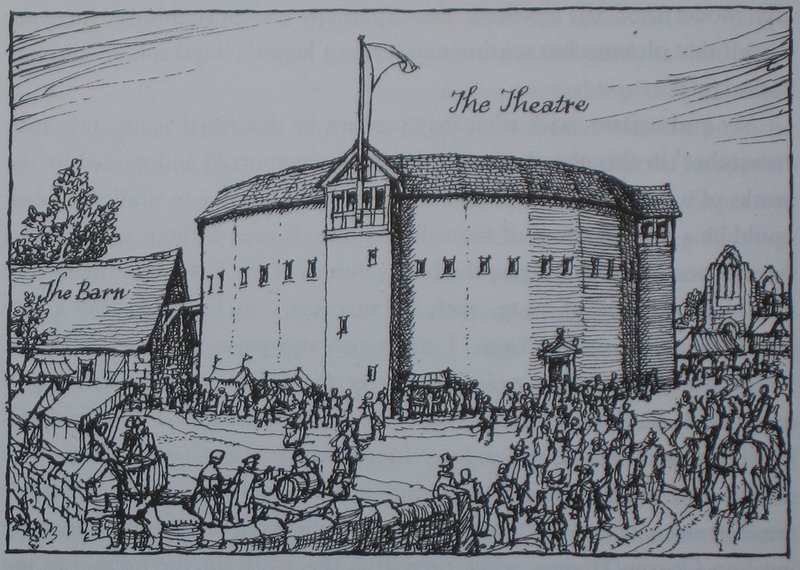
Before the Globe, before the 1560s there were no permanent building dedicate to theatre and there were travelling bands of actors and musicians traveled to and from large open spaces where they could attract a crowd; guildhalls, town halls, monasteries, in-yards. That was until 1567 "The Red Lion" in Whitechapel became a first real theatre or playhouse just dedicated to performance but it didn't last very long. It wasn't until 1576 that a proper permanent home for London theatre was built in Shoreditch by a wealthy actor and influential entrepreneur called James Burbage. He was originally a joiner but his passion for acting landed him in the makings of a first round outdoor theatre. This design was partly modeled on Roman stages with some Tudor vernacular being made out of wood for example. His actor's mid guessed that London could have been large enough to sustain a professional performance space just outside the wall city hovering near the gates. He simply called it "The Theatre". He was the one who made the decision to create professional theatre for early modern London and built "The Theatre." it ran for more than twenty years and he performed in Shakespeare's plays in Shoreditch and the Globe.

At this time there were two controlling organisations locked in a struggle for power. On one hand there was City of London corporation which loosely represents the business- minded moneyed classes and a bit outside of London Westminster city was the home of the monarchy. Their contradicting motives and this struggle eventually culminates in the English civil war but one of the main means in which they tried to claim this power was theatre. They sponsored theatre or tried to stop and censor it. Laws were becoming stricter about performing in Inns and players were being punished so this was a good time to set up a first permanent "playhouse"; a safe space for theatre. Shakespeare's earlier plays are believed to have been put on there in Shoreditch. Among these was definitely Richard the third written around 1592. The actor know to have played that villainous role way before Ian Mckellen was a man named Richard Burbage; the son of James Burbage who died in 1597 leaving him to act in Shakespeare's next great plays. The man
 QUESTION: What were the theatres or ‘playhouses’ of Shakespeare’s time like and how were plays staged in them?
 QUESTION: Who were the actors of Shakespeare’s plays and how did the experience of being an actor differ from the experience today?
After only ever having seen his great love stories acted out by men with coconuts in their shirts, I think Shakespeare would've been very happy to see our performances, or any of his plays on at the Globe today for that matter. As he didn't live till 1660 when women were finally permitted to act professionally on public stages, he would have taken the all male casts as a norm. But this did not stop him writing lyrical, empowering female leads like Bianca, Viola, Desdemona, Portia, Beatrice, Tamora, Juliet... On some level he must have been writing for the far future as he was quite ahead of his time.