Kate Tempest- My Shakespeare
https://www.youtube.com/watch?v=i_auc2Z67OM
He’s in every lover who ever stood alone beneath a window,
In every jealous whispered word,
in every ghost that will not rest.
He’s in every father with a favourite,
Every eye that stops to linger
On what someone else has got, and feels the tightening in their chest.
In every jealous whispered word,
in every ghost that will not rest.
He’s in every father with a favourite,
Every eye that stops to linger
On what someone else has got, and feels the tightening in their chest.
He’s in every young man growing boastful,
Every worn out elder, drunk all day;
muttering false prophecies and squandering their lot.
He’s there – in every mix-up that spirals far out of control – and never seems to end, even when its beginnings are forgot.
Every worn out elder, drunk all day;
muttering false prophecies and squandering their lot.
He’s there – in every mix-up that spirals far out of control – and never seems to end, even when its beginnings are forgot.
He’s in every girl who ever used her wits. Who ever did her best.
In every vain admirer,
Every passionate, ambitious social climber,
And in every misheard word that ever led to tempers fraying,
Every pawn that moves exactly as the player wants it to,
And still remains convinced that it’s not playing.
In every vain admirer,
Every passionate, ambitious social climber,
And in every misheard word that ever led to tempers fraying,
Every pawn that moves exactly as the player wants it to,
And still remains convinced that it’s not playing.
He’s in every star crossed lover, in every thought that ever set your teeth on edge, in every breathless hero, stepping closer to the ledge, his is the method in our madness, as pure as the driven snow – his is the hair standing on end, he saw that all that glittered was not gold. He knew we hadn’t slept a wink, and that our hearts were upon our sleeves, and that the beast with two backs had us all upon our knees as we fought fire with fire, he knew that too much of a good thing, can leave you up in arms, the pen is mightier than the sword, still his words seem to sing our names as they strike, and his is the milk of human kindness, warm enough to break the ice – his, the green eyed monster, in a pickle, still, discretion is the better part of valour, his letters with their arms around each others sholuders, swagger towards the ends of their sentences, pleased with what they’ve done, his words are the setting for our stories – he has become a poet who poetics have embedded themselves deep within the fabric of our language, he’s in our mouths, his words have tangled round our own and given rise to expressions so effective in expressing how we feel, we cant imagine how we’d feel without them.
See – he’s less the tights and garters – more the sons demanding answers from the absence of their fathers.
The hot darkness of your last embrace.
He’s in the laughter of the night before, the tightened jaw of the morning after,
He’s in us. Part and parcel of our Royals and our rascals.
He’s more than something taught in classrooms, in language that’s hard to understand,
he’s more than a feeling of inadequacy when we sit for our exams,
He’s in every wise woman, every pitiful villain,
Every great king, every sore loser, every fake tear,
His legacy exists in the life that lives in everything he’s written,
And me, I see him everywhere, he’s my Shakespeare.
Al Pachino- Looking for RichardThe hot darkness of your last embrace.
He’s in the laughter of the night before, the tightened jaw of the morning after,
He’s in us. Part and parcel of our Royals and our rascals.
He’s more than something taught in classrooms, in language that’s hard to understand,
he’s more than a feeling of inadequacy when we sit for our exams,
He’s in every wise woman, every pitiful villain,
Every great king, every sore loser, every fake tear,
His legacy exists in the life that lives in everything he’s written,
And me, I see him everywhere, he’s my Shakespeare.
https://www.youtube.com/watch?v=nVgdtcNwIGQ
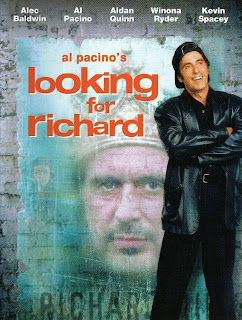 |
Al Pachino made a brilliant documentary on the importance of Shakespeare. The many characters in “Richard III” would have been roughly as familiar to the groundlings in Shakespeare's Globe theater as the figures in the O.J. Simpson case are to us. But imagine 400 years have passed, and an audience is trying to remember exactly who Kato Kaelin was. If it's true, as Al Pacino claims in “Looking for Richard,” that “Richard III” is Shakespeare's most frequently performed play, it also is true that most people leaving the theater would not be able to pass a quiz on the family tree that Richard climbs (or chops down) on his way to the crown.
“All the characters!” Pacino exclaims at one point. “Who can keep it straight?” His quick-witted documentary deals frankly with the problems of performing Shakespeare, but it also treats the work with respect and love. Going in, I expected some kind of popular vulgarization. Coming out, I had learned a lot about Richard, about Shakespeare, and about the choices that must be made in producing a play. “Looking for Richard” is not a film version of the play about Shakespeare's hunchbacked villain. (For that, you can consult Laurence Olivier's 1955 version, or Ian McKellen's 1995 film that transposed the action to a neo-Nazi 1930s England). If you add up all the line readings and scene snippets and occasional extended sequences, Pacino and his fellow actors do succeed in performing perhaps a fourth of the play, but their acting is mostly for the purposes of discussion and demonstration: This is a film about how to act and produce Shakespeare. It is also, not incidentally, a documentary about some days in the life of an actor who loves his craft and brims with curiosity and good humor.
The camera follows Pacino for months or even years (his hair grows and is cut, his beard appears and disappears) as he discusses “Richard III” in workshops and coffee shops, in Central Park and inside Shakespeare's birthplace in Stratford-upon-Avon (where the crew sets off a fire alarm).
He enlists many other actors in his ongoing seminar; we see Alec Baldwin, Estelle Parsons, Aidan Quinn, John Gielgud, Kenneth Branagh, Kevin Spacey, James Earl Jones, Vanessa Redgrave and Winona Ryder as Lady Anne (she and Pacino do the audacious scene where Richard murders Anne's husband and then proposes marriage to her as she accompanies the dead body to the grave).
The actors are honest enough to admit that Shakespeare is an acquired taste. Familiarity with the words on the page and some experience in seeing stage and film productions will eventually allow any intelligent person to appreciate that Shakespeare is the greatest of all authors, but at first he can be discouraging and bewildering. Kevin Kline, who has played many Shakespeare roles, confesses that his first exposure came at a performance of “King Lear” during which he made out with his girlfriend and they left at intermission. One of the wonderful things about Shakespeare is that many of his own characters might have done the same.
Pacino conducts the film like a magician or impresario (I was a little reminded of Orson Welles presiding over “F for Fake”). He provides a running commentary, he discusses line readings, he does man-on-the-street interviews (“It sucks,” says one guy, whose choice of pronoun indicates he thinks of Shakespeare as a thing, not a person). And he acknowledges that a problem with Shakespeare's history plays is that the characters, who were as familiar as pop stars to the Elizabethans, are largely unknown to modern American audiences. (“It's gonna take four weeks of rehearsal just to figure out which characters we're playing.”) The point is that the appreciation of Shakespeare is an ongoing project for any literate person. We pick up history and familiarity as we go along, and if we are lucky we eventually see the majesty, the humor, the sadness, the insight and the wisdom. “Looking for Richard” is the portrait of a man and his friends doing just that. Having chosen to be actors, they know they cannot respect their craft without embracing its greatest writer. Having chosen to be readers and viewers, we cannot do less, and this film is a delightful inspiration.
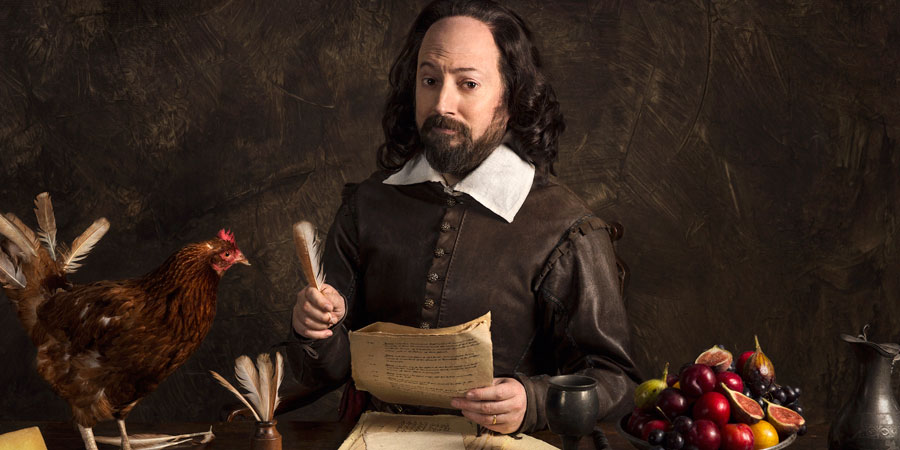
Finally I have absolutely loved this part of the reasearch... I have been watching BBC two's Upstart Crow. It's comedic interpretation of what sort of guy Shakespeare could have been and I think they got it exactly as I have always hoped he would be.
http://www.bbc.co.uk/iplayer/episode/b07bp64b
“All the characters!” Pacino exclaims at one point. “Who can keep it straight?” His quick-witted documentary deals frankly with the problems of performing Shakespeare, but it also treats the work with respect and love. Going in, I expected some kind of popular vulgarization. Coming out, I had learned a lot about Richard, about Shakespeare, and about the choices that must be made in producing a play. “Looking for Richard” is not a film version of the play about Shakespeare's hunchbacked villain. (For that, you can consult Laurence Olivier's 1955 version, or Ian McKellen's 1995 film that transposed the action to a neo-Nazi 1930s England). If you add up all the line readings and scene snippets and occasional extended sequences, Pacino and his fellow actors do succeed in performing perhaps a fourth of the play, but their acting is mostly for the purposes of discussion and demonstration: This is a film about how to act and produce Shakespeare. It is also, not incidentally, a documentary about some days in the life of an actor who loves his craft and brims with curiosity and good humor.
The camera follows Pacino for months or even years (his hair grows and is cut, his beard appears and disappears) as he discusses “Richard III” in workshops and coffee shops, in Central Park and inside Shakespeare's birthplace in Stratford-upon-Avon (where the crew sets off a fire alarm).
He enlists many other actors in his ongoing seminar; we see Alec Baldwin, Estelle Parsons, Aidan Quinn, John Gielgud, Kenneth Branagh, Kevin Spacey, James Earl Jones, Vanessa Redgrave and Winona Ryder as Lady Anne (she and Pacino do the audacious scene where Richard murders Anne's husband and then proposes marriage to her as she accompanies the dead body to the grave).
The actors are honest enough to admit that Shakespeare is an acquired taste. Familiarity with the words on the page and some experience in seeing stage and film productions will eventually allow any intelligent person to appreciate that Shakespeare is the greatest of all authors, but at first he can be discouraging and bewildering. Kevin Kline, who has played many Shakespeare roles, confesses that his first exposure came at a performance of “King Lear” during which he made out with his girlfriend and they left at intermission. One of the wonderful things about Shakespeare is that many of his own characters might have done the same.
Pacino conducts the film like a magician or impresario (I was a little reminded of Orson Welles presiding over “F for Fake”). He provides a running commentary, he discusses line readings, he does man-on-the-street interviews (“It sucks,” says one guy, whose choice of pronoun indicates he thinks of Shakespeare as a thing, not a person). And he acknowledges that a problem with Shakespeare's history plays is that the characters, who were as familiar as pop stars to the Elizabethans, are largely unknown to modern American audiences. (“It's gonna take four weeks of rehearsal just to figure out which characters we're playing.”) The point is that the appreciation of Shakespeare is an ongoing project for any literate person. We pick up history and familiarity as we go along, and if we are lucky we eventually see the majesty, the humor, the sadness, the insight and the wisdom. “Looking for Richard” is the portrait of a man and his friends doing just that. Having chosen to be actors, they know they cannot respect their craft without embracing its greatest writer. Having chosen to be readers and viewers, we cannot do less, and this film is a delightful inspiration.
Finally I have absolutely loved this part of the reasearch... I have been watching BBC two's Upstart Crow. It's comedic interpretation of what sort of guy Shakespeare could have been and I think they got it exactly as I have always hoped he would be.
http://www.bbc.co.uk/iplayer/episode/b07bp64b
